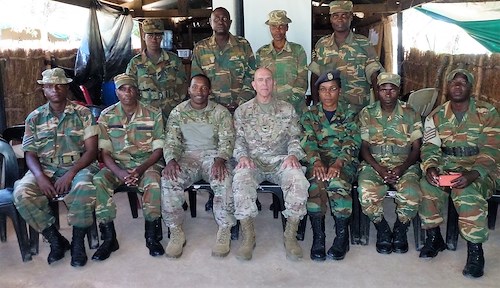
U.S. Army Africa chaplains conduct training for deploying Zambian counterparts
6:33 PM4/17/2017
Chaplain (Col.) David Lile (front row, center), the U.S. Army Africa command chaplain, poses for a group photo with Zambian army and air force chaplains at the Nanking army battle training center near Lusaka, Zambia, March 15, 2017. Lile and Sgt. 1st Class George Butler, also assigned the USARAF chaplain section based in Vicenza, Italy, discussed deployment cycle support and spiritual leadership and development components with the Zambian chaplains, who were preparing to support service members scheduled to deploy to Central African Republic and South Sudan on extended peacekeeping missions. (Courtesy photo)
AFRICOM holds forum to discuss migration challenges
5:02 PM4/10/2017
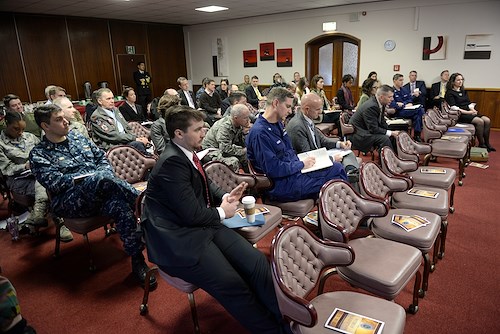
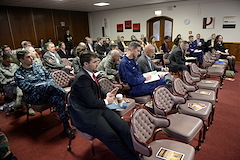
U.S. Africa Command staff members and international partners attend a migration forum hosted by AFRICOM, March 24, 2017, on Kelly Barracks, Stuttgart, Germany.
AFRICOM holds forum to discuss migration challenges
5:01 PM4/10/2017
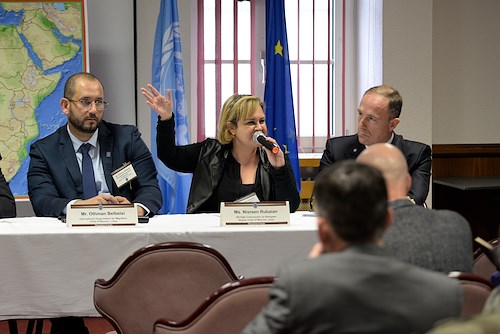
Nisreen Rubaian, senior protection officer and deputy chief of mission, United Nations High Commission onf Refugees, Libya Office, addresses attendees of a migration forum hosted by U.S. Africa Command, March 24, 2017, Kelly Barracks, Stuttgart, Germany.
Prime Minister of Libyan Government of National Accord visits AFRICOM
10:53 AM4/6/2017
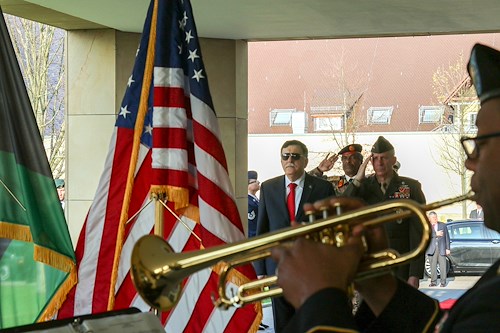
Libyan Prime Minister Fayez al-Sarraj and U.S. Marine Corps Gen. Thomas D. Waldhauser, Commander, U.S. Africa Command, salute while a quintet from the U.S. Army Europe band play the Libyan and U.S. anthems April 5, 2017 at the AFRICOM Headquarters in Stuttgart, Germany. This marks Sarraj's second visit to AFRICOM's headquarters in Germany.
Prime Minister of Libyan Government of National Accord visits AFRICOM
10:52 AM4/6/2017
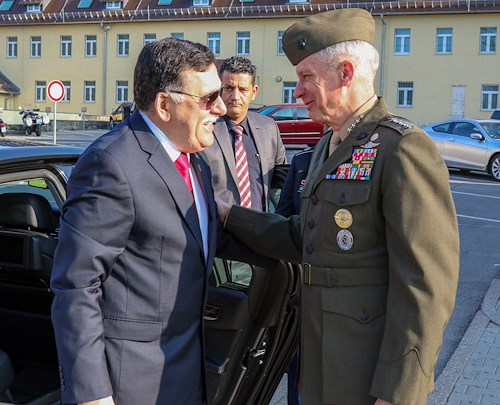
U.S. Marine Corps Gen. Thomas D. Waldhauser, Commander, U.S. Africa Command greets Libyan Prime Minister Fayez al-Sarraj during a visit April 5, 2017 at the AFRICOM headquarters in Stuttgart, Germany.
AFRICOM science advisors focus on solving warfighter challenges
4:50 PM3/22/2017
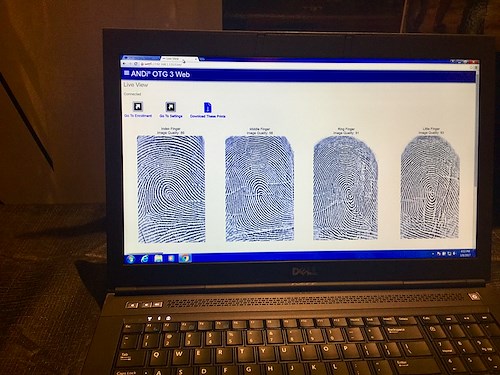
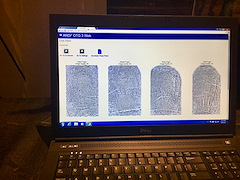
A touchless fingerprint scanner system for capturing finger prints for biometrics with the simple pass of a hand over a sensor was an emerging technology on display at the U.S. Pacific Command Operational Science and Technology Conference March 6 to 10 in Honolulu. The U.S. Africa Command science advisory team attended the conference to exchange information on ways to respond to capability gaps as well as enhance partner nation capability. (U.S. Africa Command photo courtesy of Ricardo Arias)
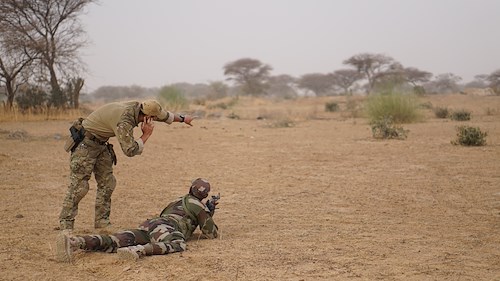
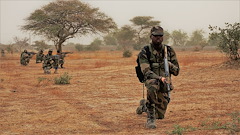
A Belgian Special Operations Forces service member shows a Nigerien soldier his sector of fire while reacting to contact on a dismounted patrol during Exercise Flintlock 2017 in Diffa, Niger, March 11, 2017. Flintlock bolsters partnerships between African, European and North American Special Operations Forces which increases their ability to work together in response to crises. (U.S. Army photo by Spc. Zayid Ballesteros/Released)
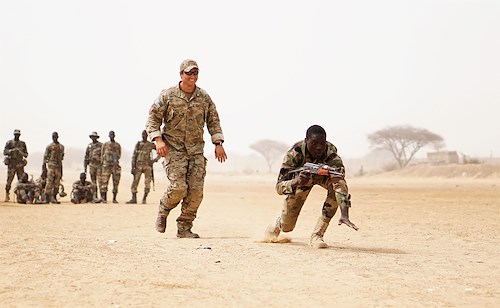
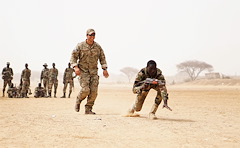
A U.S. Army Special Forces weapons sergeant observes as a Nigerien soldier bounds forward while practicing buddy team movement drills during Exercise Flintlock 2017 in Diffa, Niger, March 11, 2017. Flintlock is a Special Operations Forces exercise geared toward building interoperability between African and western partner nations. (U.S. Army photo by Spc. Zayid Ballesteros/Released)
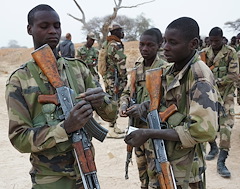
Nigerien soldiers prepare their magazines for a dismounted patrol during Exercise Flintlock 2017 in Diffa, Niger, March 11, 2017. Flintlock brings together forces who share the common goal of peace and stability in North and West Africa. (U.S. Army photo by Spc. Zayid Ballesteros/Released)
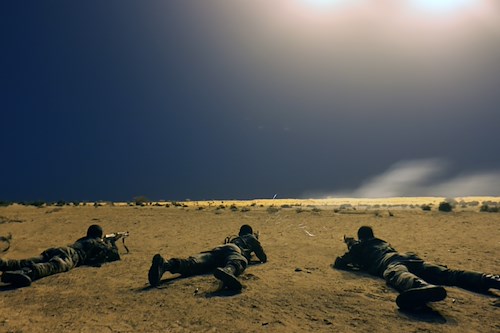
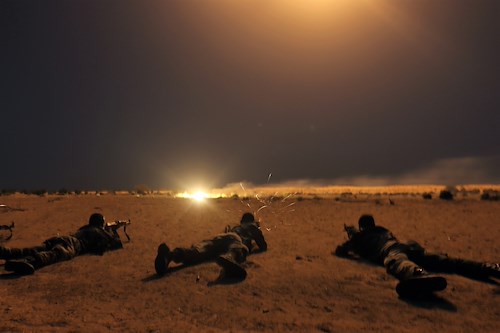
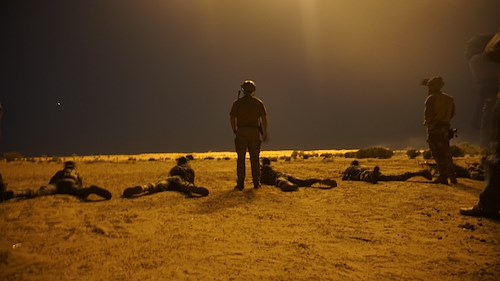
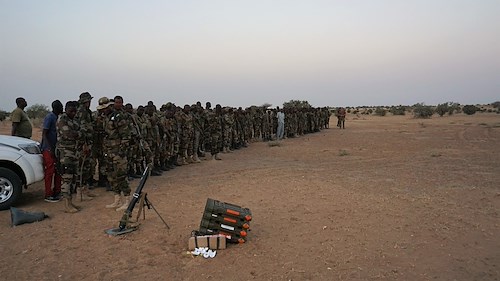
Nigerien soldiers shoot targets under 60mm illumination mortar rounds as a part of Exercise Flintlock 2017 in Diffa, Niger, March 9, 2017. Skills learned at Flintlock enable warriors in the multinational fight against violent extremist organizations. (Photo by Staff Sgt. Kulani Lakanaria/Released)
Nigerien army soldiers shoot targets under 60mm illumination mortar rounds as a part of Exercise Flintlock 2017 in Diffa, Niger, March 9, 2017. Skills learned at Flintlock enable warriors in the multinational fight against violent extremist organizations. (Photo by Staff Sgt. Kulani Lakanaria/Released)
U.S. Army Special Forces soldiers observe as Nigerien armed forces service members fire their weapons with the assistance of illumination rounds during Exercise Flintlock 2017 in Diffa, Niger, March 9, 2017. Flintlock is a Special Operations Forces exercise geared toward building interoperability between African and western partner nations. (U.S. Army photo by Spc. Zayid Ballesteros/Released)
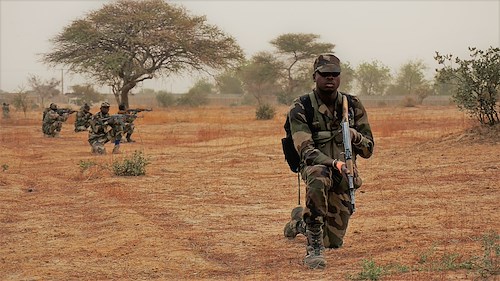
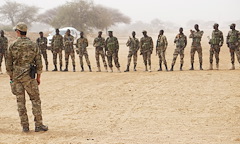
A Nigerien soldier provides rear security for his squad while they performed a dismounted patrol during Exercise Flintlock 2017 in Diffa, Niger, March 11, 2017. Flintlock exercises strengthen security institutions, promote multilateral sharing of information, and develop interoperability among partner nations in the Trans-Sahara. (U.S. Army photo by Spc. Zayid Ballesteros/Released)
Nigerien armed forces service members observe as the Belgian Special Operations Forces prepare for a capabilities demonstration during Exercise Flintlock 2017 in Diffa, Niger, March 9, 2017. Flintlock bolsters partnerships between African, European and North American Special Operations Forces which increases their ability to work together in response to crises. (U.S. Army photo by Spc. Zayid Ballesteros/Released)
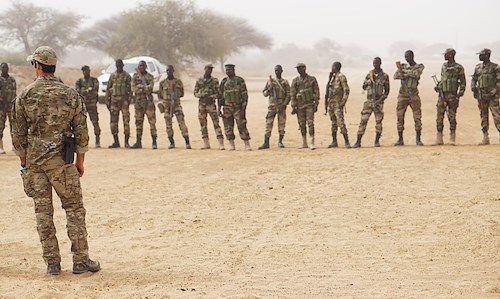
A U.S. Army Special Forces weapons sergeant speaks to a group of Nigerien soldiers prior to the start of a buddy team movement class during Exercise Flintlock 2017 in Diffa, Niger, March 11, 2017. Flintlock 2017 is designed to strengthen the ability of key partner nations in the region to protect their borders and provide security for their people. (U.S. Army photo by Spc. Zayid Ballesteros)
Tactical combat casualty care training part of Flintlock 2017
6:14 PM3/14/2017
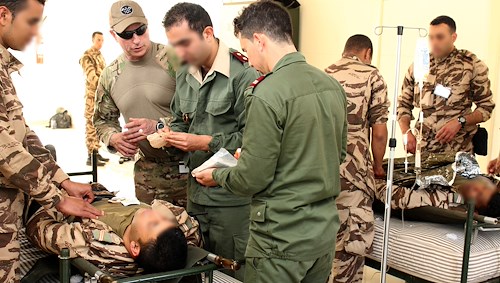
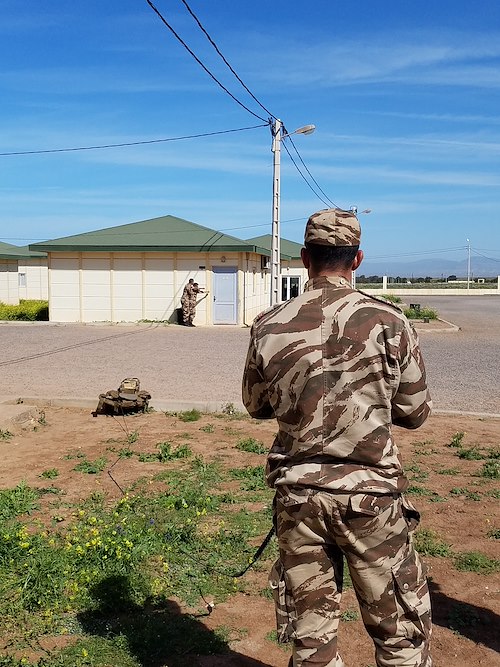
Special operations forces personnel from the Moroccan Royal Armed Forces conduct a training session on tactical combat casualty care during Exercise Flintlock 2017. The FAR personnel were joined by their partners from U.S. Marine Corps Forces, Special Operations Command. The exercise presents the opportunity for the two partners to enhance their interoperability and gain valuable lessons learned and best practices. The shared experiences strengthen the networked approach to collectively address regional operations in all mission areas. (Photo by Maj. Nicholas Mannweiler/Released)
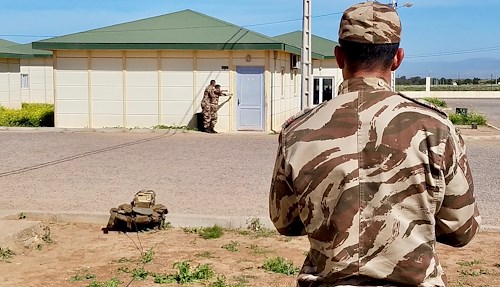
A member of the Moroccan special operations forces employs a Next Generation Loudspeaker System during training focused on military information support operations, March 6, 2017 in Tifnit, Morocco. MISO instructors from Special Operations Command Forward Northwest Africa partnered with critical skills operators from Marine Corps Forces, Special Operations Command and their Moroccan counterparts for Exercise Filntlock 2017, the tenth iteration of Africa's largest special operations exercise. Flintlock provides opportunities for SOF partners from 24 nations to improve their interoperability and build capacity in the fight against trans-regional threats and violet extremist organizations. (U.S. Army photo by Sgt. Brian Hardy/Released)
A member of the Moroccan special operations forces employs a Next Generation Loudspeaker System during training focused on military information support operations, 6 March 2017 in Tifnit, Morocco. MISO instructors from Special Operations Command Forward Northwest Africa partnered with critical skills operators from Marine Corps Forces, Special Operations Command and their Moroccan counterparts for Exercise Filntlock 2017, the tenth iteration of Africa's largest special operations exercise. Flintlock provides opportunities for SOF partners from 24 nations to improve their interoperability and build capacity in the fight against trans-regional threats and violet extremist organizations. (U.S. Army photo by Sgt. Brian Hardy/Released)
Commander delivers annual statement to the Senate House Services Committee
10:31 PM3/9/2017
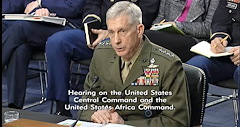
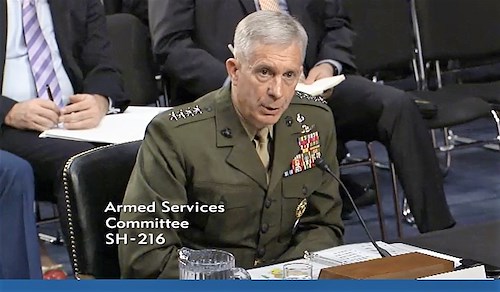
Commander U.S. Africa Command General Thomas Waldhauser provides information to members of the U.S. Senate Committee on Armed Services (SASC) during a hearing held on March 9, 2017 in Washington DC.
Waldhauser appeared before the committee for an annual session that allows members the opportunity receive updates from commanders and ask questions that inform decisions. During the hearing, Waldhauser submitted U.S. AFRICOM’s official annual posture statement and answered questions related to the command’s area of responsibility on topics ranging from counter-terrorism initiatives to the influence of other countries upon the African continent. (Courtesy image)
Commander delivers annual statement to the Senate House Services Committee
10:28 PM3/9/2017
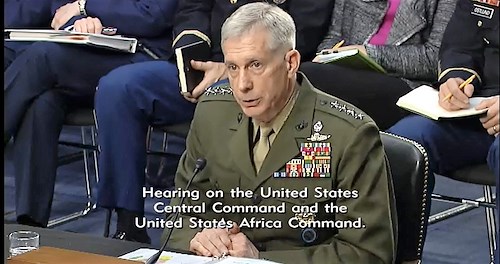
Commander U.S. Africa Command General Thomas Waldhauser provides information to members of the U.S. Senate Committee on Armed Services (SASC) during a hearing held on March 9, 2017 in Washington, DC.
Waldhauser appeared before the committee for an annual session that allows members the opportunity receive updates from commanders and ask questions that inform decisions. During the hearing, Waldhauser submitted U.S. AFRICOM’s official annual posture statement and answered questions related to the command’s area of responsibility on topics ranging from counter-terrorism initiatives to the influence of other countries upon the African continent. (Courtesy image)