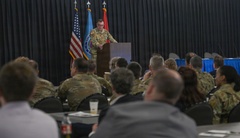
Africom Commander: Terror Threat Remains Across Africa

Helped by the Arab Spring, terrorist groups in North and West Africa have expanded their operations, increasing threats to the United States and its interests, the commander of U.S. Africa Command told Congress today.


By Nick Simeone American Forces Press Service WASHINGTON Mar 10, 2014

Helped by the Arab Spring, terrorist groups in North and West Africa have expanded their operations, increasing threats to the United States and its interests, the commander of U.S. Africa Command told Congress today.

“These revolutions, coupled with the fragility of neighboring states, continue to destabilize the region,” Army Gen. David M. Rodriguez told the Senate Armed Services Committee in prepared testimony.

“The spillover effects of revolutions include the return of fighters and flow of weapons from Libya to neighboring countries following the fall of the Gadhafi regime and the export of foreign fighters from North Africa to the Syrian conflict,” the general said.

Rodriguez described the security situation in Libya -- where a NATO-backed air campaign in 2011 aimed at protecting civilians from pro-Gadhafi forces eventually led to the leader’s overthrow -- as volatile and tenuous, especially in the east and southwest. “Militia groups control significant areas of territory and continue to exert pressure on the Libyan government,” he said.

Africom, he said, is working to help build Libyan security forces, but in the meantime, terrorist groups including those affiliated with al-Qaida have taken root in vast, lawless areas of the country and are using the region as a base to extend their reach across northwest Africa.

Farther west, though, Rodriguez pointed to success the United States and its French and African allies have had in stabilizing Mali, where Islamic extremists took control of a large swath of the desert country’s north following a coup two years ago. “U.S. support has enabled [United Nations forces] and French operations to secure key cities and disrupt terrorist organizations,” he added.

Rodriguez described challenges facing the United States and Europe across the continent, from the Sahael region in West Africa to Somalia in the east.

“The collective aftermath of revolutions in Libya, Tunisia and Egypt, including uncertain political transitions, spillover effects, and exploitation by violent extremist organizations of under-governed spaces and porous borders are key sources of instability that require us to remain vigilant in the near term,” he said. While multi-national efforts are disrupting terrorists, he added, “the growth and activity of the violent extremist network across the African continent continues to outpace these efforts.”

Rodriguez ticked off a list of security challenges facing the continent and his command.

Despite programs and exercises with Nigeria, the terrorist group Boko Haram continues to attack civilian and government facilities and has extended its reach into neighboring Niger, Chad and Cameroon. In Somalia, after having no presence in the country for years, the U.S. military now has three people on the ground, he said, to coordinate with U.N. and other partnered forces to disrupt and contain al-Shabaab forces and expand areas under the control of the nominal government in Mogadishu.

He described the efforts as playing “limited, but important roles” in weakening the militant group, which controls portions of the country and claimed responsibility for a massacre at a shopping mall in Nairobi, Kenya, in September that killed more than 60 people.

Rodriguez reported significant progress in reducing piracy.

“In 2013, zero ships were hijacked in nine attempted attacks in the region,” he said. Just two years earlier, there had been more than 150 attempted hijackings.

While Rodriguez said Africom is using military-to-military engagements, programs, exercises and other operations to respond to crises and deter threats, he emphasized that these efforts are geared toward enabling African partners to handle these problems.

“We believe efforts to meet security challenges in Africa are best led and conducted by African partners,” he said, efforts that ultimately will depend on African nations developing effective partner-nation security institutions that respect civilian authority.

For more, visit http://www.defense.gov/news/newsarticle.aspx?id=121787

More in Media Room
U.S. Forces Conduct Strikes Targeting ISIS-Somalia
In coordination with the Federal Government of Somalia, U.S. Africa Command (AFRICOM) conducted airstrikes targeting ISIS-Somalia from Feb. 22-26, and Feb. 28, 2026.The airstrikes occurred in the vicinity of the Golis Mountains, approximately 70km southeast of Bossaso.
Read more
Justified Accord 2026 begins in Kenya, Tanzania, Djibouti
Exercise Justified Accord 2026 (JA26), U.S. Africa Command’s largest annual, multinational exercise in East Africa, officially begins today across Djibouti, Kenya and Tanzania. Led by U.S. Army Southern European Task Force, Africa (SETAF-AF), JA26 integrates approximately 1,500 personnel from Djibouti, Kenya, Tanzania, the United States and several other nations to build readiness, deepen partnerships and strengthen regional security.
Read more
AFRICOM Tech Expo connects innovators with mission-critical needs
The Kelley Barracks fitness center transformed into a hub of innovation as U.S. Africa Command personnel connected with technology experts at the AFRICOM Tech Expo, Feb. 24, 2026.
Read more
More in Media Room
U.S. Forces Conduct Strikes Targeting ISIS-Somalia
In coordination with the Federal Government of Somalia, U.S. Africa Command (AFRICOM) conducted airstrikes targeting ISIS-Somalia from Feb. 22-26, and Feb. 28, 2026.The airstrikes occurred in the vicinity of the Golis Mountains, approximately 70km southeast of Bossaso.
Read more
Justified Accord 2026 begins in Kenya, Tanzania, Djibouti
Exercise Justified Accord 2026 (JA26), U.S. Africa Command’s largest annual, multinational exercise in East Africa, officially begins today across Djibouti, Kenya and Tanzania. Led by U.S. Army Southern European Task Force, Africa (SETAF-AF), JA26 integrates approximately 1,500 personnel from Djibouti, Kenya, Tanzania, the United States and several other nations to build readiness, deepen partnerships and strengthen regional security.
Read more
AFRICOM Tech Expo connects innovators with mission-critical needs
The Kelley Barracks fitness center transformed into a hub of innovation as U.S. Africa Command personnel connected with technology experts at the AFRICOM Tech Expo, Feb. 24, 2026.
Read more
More in Media Room
U.S. Forces Conduct Strikes Targeting ISIS-Somalia
In coordination with the Federal Government of Somalia, U.S. Africa Command (AFRICOM) conducted airstrikes targeting ISIS-Somalia from Feb. 22-26, and Feb. 28, 2026.The airstrikes occurred in the vicinity of the Golis Mountains, approximately 70km southeast of Bossaso.
Read more
Justified Accord 2026 begins in Kenya, Tanzania, Djibouti
Exercise Justified Accord 2026 (JA26), U.S. Africa Command’s largest annual, multinational exercise in East Africa, officially begins today across Djibouti, Kenya and Tanzania. Led by U.S. Army Southern European Task Force, Africa (SETAF-AF), JA26 integrates approximately 1,500 personnel from Djibouti, Kenya, Tanzania, the United States and several other nations to build readiness, deepen partnerships and strengthen regional security.
Read more
AFRICOM Tech Expo connects innovators with mission-critical needs
The Kelley Barracks fitness center transformed into a hub of innovation as U.S. Africa Command personnel connected with technology experts at the AFRICOM Tech Expo, Feb. 24, 2026.
Read more