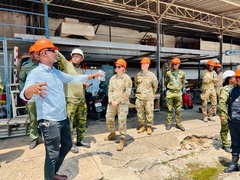
United States Extends Friendly Hand to East Africa

The U.S. Navy, the U.S. Coast Guard and the National Oceanic and Atmospheric Administration, which have extended a helping hand to a number of West African countries in the past few years, are now reaching out to East Africa, too. <br /> <br />The


By Jacquelyn S. Porth Staff Writer America.gov WASHINGTON, D.C. Mar 20, 2009
The U.S. Navy, the U.S. Coast Guard and the National Oceanic and Atmospheric Administration, which have extended a helping hand to a number of West African countries in the past few years, are now reaching out to East Africa, too. The broad program is known as the Africa Partnership Station (APS). It started in 2007 as an international security effort offering training and other forms of collaboration to improve maritime safety and security off the West African coast. The United States launched APS to help African nations achieve stability and economic prosperity through civilian-military maritime mentoring as well as military-to-military training. Seeing the benefits of the program, African officials on the other side of the continent asked for similar help. This paved the way for the first APS visit to Mozambique, Tanzania and Kenya this year by the USS Robert G. Bradley. The naval vessel carried a team of U.S., European, South American and African personnel that coached personnel in three host countries on ways to combat piracy; drug, weapons, and human trafficking; and fish poaching. Illegal fishing is a significant problem in East Africa. The region loses an estimated $310 million every year because it lacks the maritime infrastructure to combat the problem. That is where this kind of good neighbor initiative can make a difference. Its training focuses on information sharing that will give African maritime forces a complete image of what is happening in nearby waters through a shared communication network. Hands-on training is offered to help develop a professional maritime corps that will be ready to respond to a host of potential security challenges. U.S. Navy Captain Nicholas Holman returned recently from several weeks leading the crew of the Bradley during training, humanitarian assistance and partnership-building ventures. He said the goal of the effort is to improve ocean monitoring activities so that they will be on par with airspace monitoring efforts. Holman told the Defense Bloggers Roundtable March 11 that this is important because some of the regional navies and coast guards do not have the capability "to do much about anything that's going on in their waters." Most of the training occurred onboard, but in some cases simulated boarding of ships was conducted using small boats in the host countries. Training included instruction in navigation and handling emergencies at sea. During the Bradley's visit to Mozambique, instructors worked with indigenous forces on maritime search-and-seizure techniques. "This is a new adventure on the East Coast [of Africa]," Holman said. MARITIME SAFETY IS KEY TO SUCCESS Wherever they went, training instructors hammered home the need for maritime safety. Two African sailors died at sea in 2008 in an accident involving excessive speed. Better ship handling and crew safety are themes that Navy captains emphasize whenever they have the ear of a student audience. East African navies are also interested in acquiring more vessels. Holman said the State Department is looking at ways to provide additional Archangel patrol boats. He said Kenya is interested in resuming U.S. naval visits to its Indian Ocean port, Mombassa. Community outreach is another important aspect of the APS initiative. When a ship docks at a port, crew members disembark and head to local orphanages, schools and hospitals where they repair and repaint. The Navy pitches in and buys the paint and sailors provide the labor. This is how it worked when the sailors helped paint the Kidz Care orphanage in Dar es Salaam, Tanzania. Holman said his sailors enjoy these opportunities to interact and leave behind a lasting touch. Community outreach also entails the delivery of donated supplies through the Navy's Project Handclasp. Collected toys and personal hygiene products were carried in the Bradley's hold and distributed during shore visits.
More in Media Room
U.S. Forces Conduct Strikes Targeting ISIS-Somalia
In coordination with the Federal Government of Somalia, U.S. Africa Command (AFRICOM) conducted airstrikes targeting ISIS-Somalia from Feb. 22-26, and Feb. 28, 2026.The airstrikes occurred in the vicinity of the Golis Mountains, approximately 70km southeast of Bossaso.
Read more
Justified Accord 2026 begins in Kenya, Tanzania, Djibouti
Exercise Justified Accord 2026 (JA26), U.S. Africa Command’s largest annual, multinational exercise in East Africa, officially begins today across Djibouti, Kenya and Tanzania. Led by U.S. Army Southern European Task Force, Africa (SETAF-AF), JA26 integrates approximately 1,500 personnel from Djibouti, Kenya, Tanzania, the United States and several other nations to build readiness, deepen partnerships and strengthen regional security.
Read more
AFRICOM Tech Expo connects innovators with mission-critical needs
The Kelley Barracks fitness center transformed into a hub of innovation as U.S. Africa Command personnel connected with technology experts at the AFRICOM Tech Expo, Feb. 24, 2026.
Read more
More in Media Room
U.S. Forces Conduct Strikes Targeting ISIS-Somalia
In coordination with the Federal Government of Somalia, U.S. Africa Command (AFRICOM) conducted airstrikes targeting ISIS-Somalia from Feb. 22-26, and Feb. 28, 2026.The airstrikes occurred in the vicinity of the Golis Mountains, approximately 70km southeast of Bossaso.
Read more
Justified Accord 2026 begins in Kenya, Tanzania, Djibouti
Exercise Justified Accord 2026 (JA26), U.S. Africa Command’s largest annual, multinational exercise in East Africa, officially begins today across Djibouti, Kenya and Tanzania. Led by U.S. Army Southern European Task Force, Africa (SETAF-AF), JA26 integrates approximately 1,500 personnel from Djibouti, Kenya, Tanzania, the United States and several other nations to build readiness, deepen partnerships and strengthen regional security.
Read more
AFRICOM Tech Expo connects innovators with mission-critical needs
The Kelley Barracks fitness center transformed into a hub of innovation as U.S. Africa Command personnel connected with technology experts at the AFRICOM Tech Expo, Feb. 24, 2026.
Read more
More in Media Room
U.S. Forces Conduct Strikes Targeting ISIS-Somalia
In coordination with the Federal Government of Somalia, U.S. Africa Command (AFRICOM) conducted airstrikes targeting ISIS-Somalia from Feb. 22-26, and Feb. 28, 2026.The airstrikes occurred in the vicinity of the Golis Mountains, approximately 70km southeast of Bossaso.
Read more
Justified Accord 2026 begins in Kenya, Tanzania, Djibouti
Exercise Justified Accord 2026 (JA26), U.S. Africa Command’s largest annual, multinational exercise in East Africa, officially begins today across Djibouti, Kenya and Tanzania. Led by U.S. Army Southern European Task Force, Africa (SETAF-AF), JA26 integrates approximately 1,500 personnel from Djibouti, Kenya, Tanzania, the United States and several other nations to build readiness, deepen partnerships and strengthen regional security.
Read more
AFRICOM Tech Expo connects innovators with mission-critical needs
The Kelley Barracks fitness center transformed into a hub of innovation as U.S. Africa Command personnel connected with technology experts at the AFRICOM Tech Expo, Feb. 24, 2026.
Read more