Dr. Steven Livingston Speaks on Emerging Communication Technology in Africa

Emerging communication technology in Africa is changing the way Africans get their information and providing unprecedented opportunities for the development of security-monitoring programs, banking services, and more, said a world-renowned


By Danielle Skinner U.S. AFRICOM Public Affairs STUTTGART, Germany Dec 21, 2010
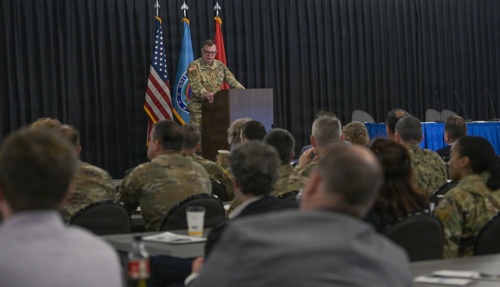
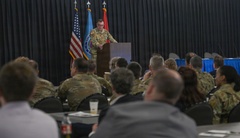
Emerging communication technology in Africa is changing the way Africans get their information and providing unprecedented opportunities for the development of security-monitoring programs, banking services, and more, said a world-renowned communications expert during a presentation at U.S. Africa Command headquarters, December 14, 2010.

Dr. Steven Livingston, professor for Political Communication and International Affairs at George Washington University, discussed the research project he conducted for the Africa Center for Strategic Studies on media and communication technology in Africa. His research paper was called "Africa's Evolving Infosystems: A Pathway to Security and Stability."

Livingston explained that mobile telephony is filling the need for reliable information in Africa, where legacy media (radio, newspapers, television, etc.) has failed due to information-constrained environments. Legacy media requires certain conditions to be effective, such as the availability of electricity for radio and a high literacy rate and well-developed road infrastructure for newspapers or magazines to be delivered. Additionally, in countries lacking freedom of the press, rumors and misinformation often fuel political tensions and violence in Africa.

"Where do we turn for some sort of information conveyance, some sort of information-sharing mechanism that doesn't rely on the legacy media? And my attention turned to a series of nested technologies," said Livingston.

Nested technology, he explained, refers to mobile telephony, cell phones, remote sensing satellites, and geographical information systems paired with GPS.

The annual growth rate for mobile telephony in Africa has been 65 percent over the past five years, more than twice the global average. The high use of mobile phones in Africa combined with radio communication has contributed to the creation of institutions that promote transparency, accountability, and security. Non-governmental organizations (NGOs) and other organizations are now using mobile telephony to provide people in even the most remote areas of Africa with banking services, health services, and agricultural information. Additionally, Geographic Information Systems (GIS) is being used to track and monitor events, also called crisis mapping.

"The growth rate here is exponential and it's also part of a global phenomenon. So one of the things with any sort of network connectivity: When you grow it, you're creating a global community," Livingston stated.

In an interview following the presentation, he emphasized that this is ultimately an African initiative.

"It's up to Africa to find ways to imaginatively and constructively utilize these technologies to improve their life and well-being. This is very much an Africa project. This is something that Africans can do for Africans…" he said.

Livingston also acknowledged that information technologies can also be used for less positive purposes, including crime and politically motivated violence.

"If you are living in an environment that's connected, the only thing that you can change are the motivations. How do you change motivations? By leveraging the positive change that's available to you through increased health care, banking services, agricultural services. In the absence of that, the information space is going to be filled by the hate-mongers. It's going to be filled by the al-Qaida types that will take advantage of these tools to their own purposes."

Dr. Livingston's work is in support of U.S. Africa Command Commander's Strategic Research Program--dedicated to researching understudied topics that have long-term command implications. The researcher's goal is to prepare the command for sudden change and facilitate decision-making, long-term planning, strategic partnerships, and joint research projects.

For more information: View the complete transcript of Dr. Livingston's presentation.
More in Media Room
U.S. Forces Conduct Strikes Targeting ISIS-Somalia
In coordination with the Federal Government of Somalia, U.S. Africa Command (AFRICOM) conducted airstrikes targeting ISIS-Somalia from Feb. 22-26, and Feb. 28, 2026.The airstrikes occurred in the vicinity of the Golis Mountains, approximately 70km southeast of Bossaso.
Read more
Justified Accord 2026 begins in Kenya, Tanzania, Djibouti
Exercise Justified Accord 2026 (JA26), U.S. Africa Command’s largest annual, multinational exercise in East Africa, officially begins today across Djibouti, Kenya and Tanzania. Led by U.S. Army Southern European Task Force, Africa (SETAF-AF), JA26 integrates approximately 1,500 personnel from Djibouti, Kenya, Tanzania, the United States and several other nations to build readiness, deepen partnerships and strengthen regional security.
Read more
AFRICOM Tech Expo connects innovators with mission-critical needs
The Kelley Barracks fitness center transformed into a hub of innovation as U.S. Africa Command personnel connected with technology experts at the AFRICOM Tech Expo, Feb. 24, 2026.
Read more
More in Media Room
U.S. Forces Conduct Strikes Targeting ISIS-Somalia
In coordination with the Federal Government of Somalia, U.S. Africa Command (AFRICOM) conducted airstrikes targeting ISIS-Somalia from Feb. 22-26, and Feb. 28, 2026.The airstrikes occurred in the vicinity of the Golis Mountains, approximately 70km southeast of Bossaso.
Read more
Justified Accord 2026 begins in Kenya, Tanzania, Djibouti
Exercise Justified Accord 2026 (JA26), U.S. Africa Command’s largest annual, multinational exercise in East Africa, officially begins today across Djibouti, Kenya and Tanzania. Led by U.S. Army Southern European Task Force, Africa (SETAF-AF), JA26 integrates approximately 1,500 personnel from Djibouti, Kenya, Tanzania, the United States and several other nations to build readiness, deepen partnerships and strengthen regional security.
Read more
AFRICOM Tech Expo connects innovators with mission-critical needs
The Kelley Barracks fitness center transformed into a hub of innovation as U.S. Africa Command personnel connected with technology experts at the AFRICOM Tech Expo, Feb. 24, 2026.
Read more
More in Media Room
U.S. Forces Conduct Strikes Targeting ISIS-Somalia
In coordination with the Federal Government of Somalia, U.S. Africa Command (AFRICOM) conducted airstrikes targeting ISIS-Somalia from Feb. 22-26, and Feb. 28, 2026.The airstrikes occurred in the vicinity of the Golis Mountains, approximately 70km southeast of Bossaso.
Read more
Justified Accord 2026 begins in Kenya, Tanzania, Djibouti
Exercise Justified Accord 2026 (JA26), U.S. Africa Command’s largest annual, multinational exercise in East Africa, officially begins today across Djibouti, Kenya and Tanzania. Led by U.S. Army Southern European Task Force, Africa (SETAF-AF), JA26 integrates approximately 1,500 personnel from Djibouti, Kenya, Tanzania, the United States and several other nations to build readiness, deepen partnerships and strengthen regional security.
Read more
AFRICOM Tech Expo connects innovators with mission-critical needs
The Kelley Barracks fitness center transformed into a hub of innovation as U.S. Africa Command personnel connected with technology experts at the AFRICOM Tech Expo, Feb. 24, 2026.
Read more