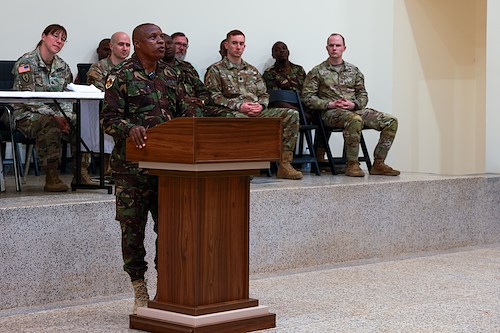
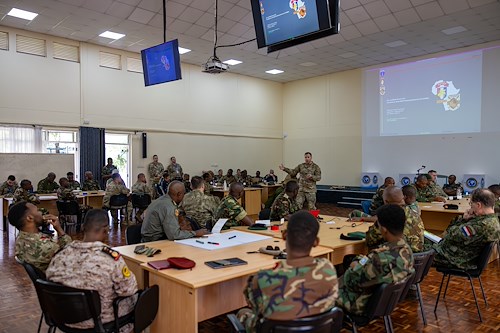
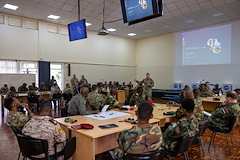
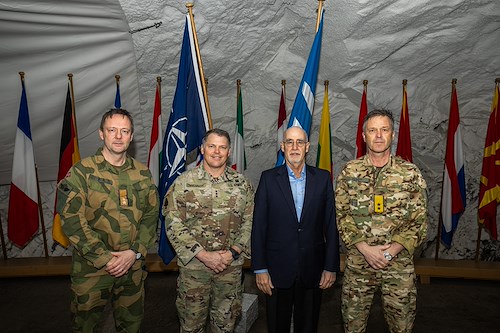
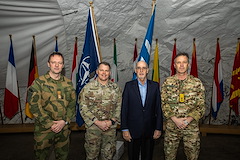
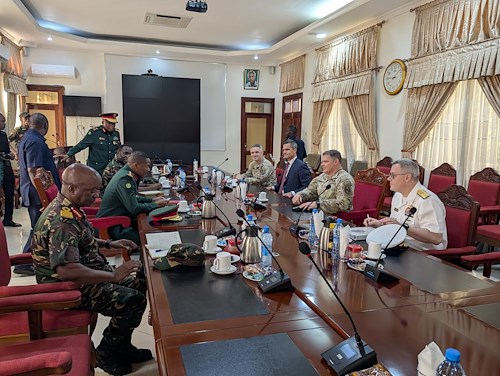
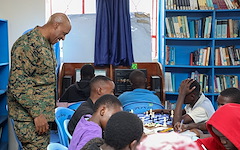
Kenya Defence Forces (KDF) Brig. William Kamoiro, KDF exercise director for Justified Accord 2025 (JA25), addresses multinational partners during JA25 at the Counter Insurgency Terrorism and Stability Operations Center in Nanyuki, Kenya, Feb. 11, 2025. JA25 is the premier U.S. Africa Command (USAFRICOM) exercise in East Africa, designed to enhance multinational combat readiness, strengthen crisis response capabilities and empower allies and partners in the region. Led by U.S. Army Southern European Task Force, Africa (SETAF-AF) and hosted in Kenya, Djibouti and Tanzania, JA25 integrates high-intensity training scenarios that sharpen warfighting skills, increase operational reach and enhance the ability to execute complex joint and multinational operations. The exercise runs from Feb. 10–21, 2025. (U.S. Army photo by Sgt. Kylejian Francia)
Army lawyers provide training on rules for armed conflict at exercise Justified Accord
10:05 AM3/26/2025
NAIROBI, Kenya – Among the flurry of tactical live fires and squad movement drills, air ground integration and even the humanitarian initiatives at exercise Justified Accord 2025 (JA25), lies the one thing those who serve in any armed force must follow: The Law.
The Law of Armed Conflict, or LOAC, is a key aspect of training for any military. JA25’s academics course aimed at learning from the international legal lessons of previous wars in an effort to reduce the amount of human suffering in future conflicts.
“The soldier’s rules are a broad set of rules that we have pulled from the large breadth of international law,” said U.S. Army Maj. Tim Olliges, an operational law attorney assigned to U.S. Army Southern European Task Force, Africa (SETAF-AF), the lead U.S. Army command and planner of JA25. “The LOAC is extensive and can be complex, so we pull out the ten most critical concepts that every soldier, right down to the private, should know before they go into combat.”
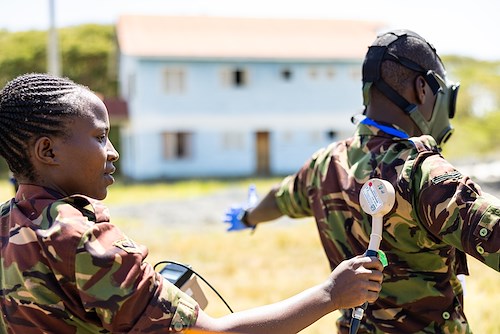
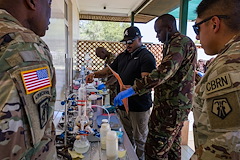
A Kenya Defence Forces (KDF) soldier uses a detection wand to scan another KDF member for potential contamination during chemical, biological, radiological and nuclear (CBRN) training at the Humanitarian Peace Support School in Nairobi, Kenya, Feb. 18, 2025. Conducted as part of exercise Justified Accord 2025 (JA25), the training enhances KDF personnel’s ability to detect and mitigate hazardous threats in operational environments.
JA25 is the premier U.S. Africa Command (USAFRICOM) exercise in East Africa, designed to enhance multinational combat readiness, strengthen crisis response capabilities and empower allies and partners in the region. Led by U.S. Army Southern European Task Force, Africa (SETAF-AF) and hosted by Kenya, Djibouti and Tanzania, JA25 integrates high-intensity training scenarios that sharpen warfighting skills, increase operational reach and enhance the ability to execute complex joint and multinational operations. The exercise runs from Feb. 10–21, 2025. (U.S. Army photo by Sgt. 1st Class Solomon Navarro)
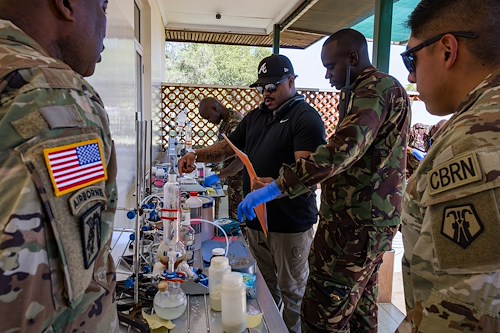
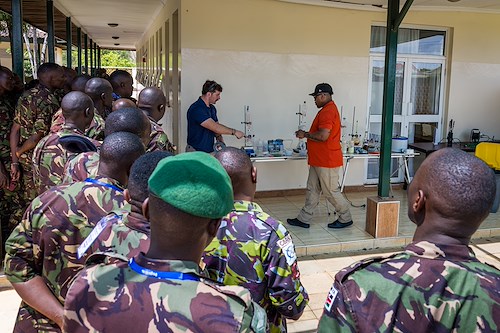
Keith Weatherspoon Jr., a chemical-biological software integrator with U.S. Africa Command’s (USAFRICOM) Technical Support Group, conducts training on chemical and biological warfare for Botswana Defence Force (BDF) partners and U.S. service members during exercise Justified Accord 2025 (JA25) at the Humanitarian Peace Support School in Nairobi, Kenya, Feb. 17, 2025. In this session, Weatherspoon explained a fentanyl lab scenario and mustard agent synthesis to enhance participants’ understanding of hazardous material threats and response procedures.
JA25 is the premier USAFRICOM exercise in East Africa, designed to enhance multinational combat readiness, strengthen crisis response capabilities and empower allies and partners in the region. Led by U.S. Army Southern European Task Force, Africa (SETAF-AF) and hosted by Kenya, Djibouti and Tanzania, JA25 integrates high-intensity training scenarios that sharpen warfighting skills, increase operational reach and enhance the ability to execute complex joint and multinational operations. The exercise runs from Feb. 10–21, 2025. (U.S. Army photo by Sgt. 1st Class Solomon Navarro)
US, Kenya prepare for the unimaginable CBRN threat
10:00 AM3/26/2025
NAIROBI, Kenya – Imagine two scenarios.
Scenario 1: Dawn breaks over the capital of Kenya. A U.S. diplomat leaves his residence for the embassy. After a 20-minute ride, his car arrives at the gate and he enters. He sits in his office to begin the day when, all of a sudden, he hears an explosion through the open window. It seems far off; it is not a large explosion. He thinks maybe it was just a car accident, but minutes later he smells something bitter in the air. His eyes water, sirens blare and a U.S. Marine Corps security detail enters his office wearing gas masks. They put a mask on him and tell him they must evacuate immediately because a deadly chemical is blowing over the compound.
Scenario 2: U.S. intelligence receives credible information that radiological material is being loaded onto a ship in the Kenyan port city of Mombasa. Time is short and no one knows which ship, only that it will embark soon, possibly bound for the hands of violent extremists or other state actors looking to imperil the U.S. homeland. There is no time to send U.S. security forces to intercept the package. Instead, the Kenyan Disaster Response Battalion (DRB) mobilizes and arrives at the port. Using tactics and tools gained from years of training with the United States, they find the ship and the weapon, placed there by a violent extremist organization, and prevent its departure, defeating the threat to America and its citizens.
Similar scenarios have happened before in other areas of the world.
AFRICOM and Norwegian Military Leaders Strengthen Maritime Security Cooperation in Africa
10:10 AM3/25/2025
A delegation from U.S. Africa Command (AFRICOM) concluded a series of meetings with Norwegian military and civilian officials in Oslo, March 18-20, addressing maritime challenges that threaten international security interests and stability in Africa.
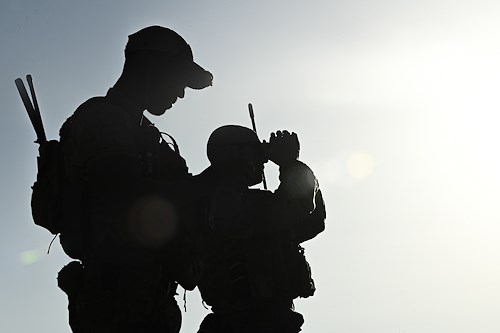
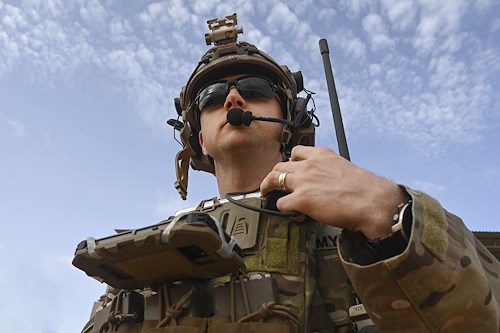
250226-F-UN699-1053: Two U.S. Army joint terminal attack controllers conduct reconnaissance of the Libyan desert alongside Libyan pilots in preparation for a B-52H Stratofortress bomber task force demonstration to promote the process of reunification of Libyan military and security institutions, conducted near Sirte, Libya, Feb. 26, 2025. These missions enhance joint force lethality and deter aggression by highlighting the U.S. ability to project power globally for the collective defense and security of the U.S. homeland, partners and allies. (U.S. Air Force photo by Staff Sgt. Jake Carter)
250225-F-UN699-1140: A U.S. Army joint terminal attack controller uses his android tactical assault kit to demonstrate the marking of target points to Libyan pilots in preparation for a B-52H Stratofortress bomber task force demonstration to promote the process of reunification of Libyan military and security institutions near Sirte, Libya, Feb. 26, 2025. These missions enhance joint force lethality and deter aggression by highlighting the ability to project power globally for the collective defense and security of the U.S. homeland, partners and allies. (U.S. Air Force photo by Staff Sgt. Jake Carter)
Deputy Commander Strengthens Partnerships in Tanzania
12:36 PM2/26/2025
Lt. Gen. John Brennan, U S. Africa Command Deputy Commander, traveled to Dar es Salaam, Tanzania, Feb. 20-21 to meet with the Chief of Tanzanian People 's Defence Forces Gen. Jacob John Mkunda, and to be the keynote speaker at the closing ceremony for Exercise Cutlass Express.
Secretary of Defense Pete Hegseth Visits U.S. Africa Command
5:16 PM2/11/2025
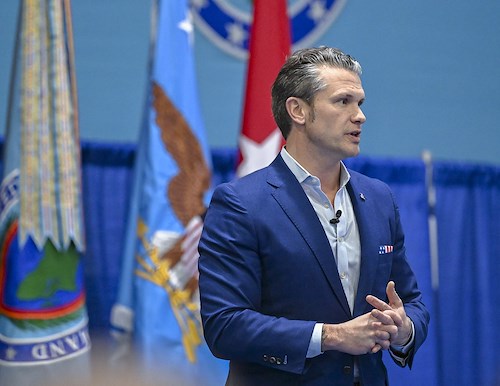
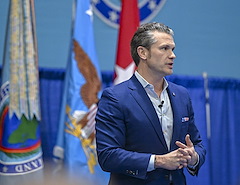
Secretary of Defense Pete Hegseth addresses U.S. Africa Command personnel during a town hall meeting Feb. 11, 2025, at Kelley Barracks in Stuttgart, Germany. Headquartered in Stuttgart, Germany, U.S. Africa Command is one of seven U.S. geographic combatant commands, responsible for military engagement across 53 African nations. Working with partners and allies, the command counters malign actors and transnational threats, responds to crises, strengthens African security forces, and supports U.S. government efforts in Africa to advance U.S. national interests and promote regional security, stability, and prosperity.
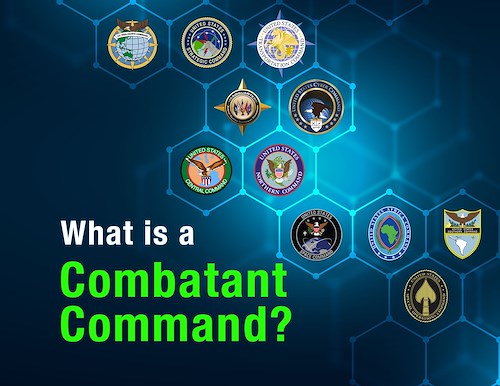
A Combatant Command is a military organization that coordinates and directs operations in a specific area of responsibility. The Department of Defense splits their efforts around the world by region, and each Combatant Command is responsible for military operations in its assigned area.
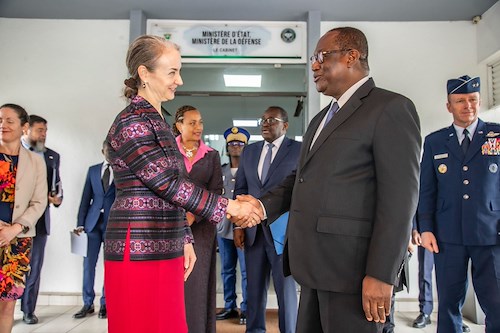
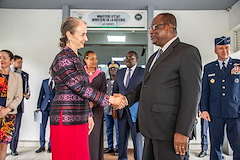
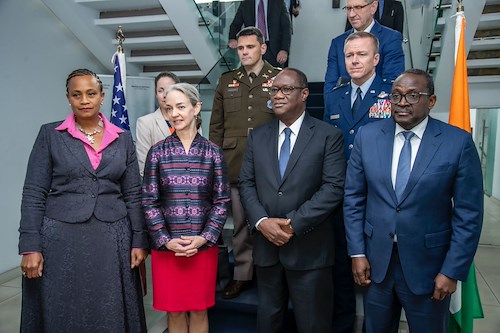
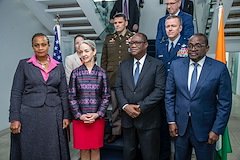
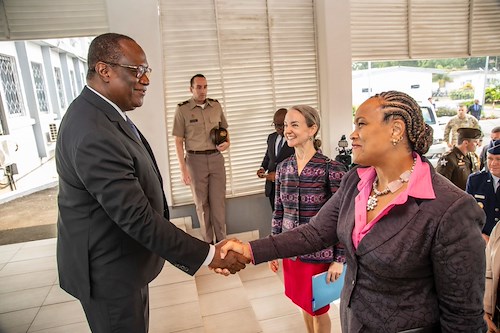
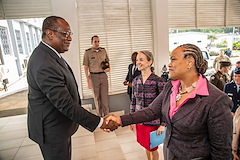
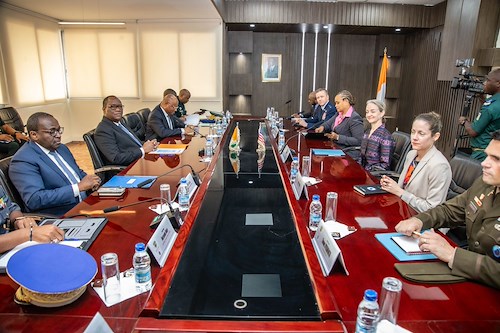
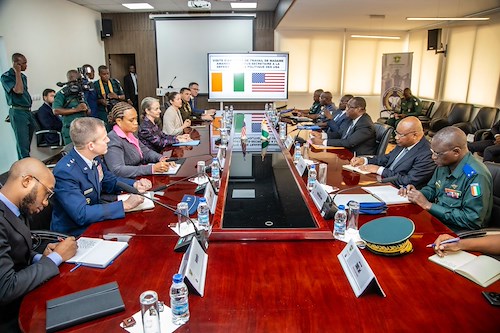
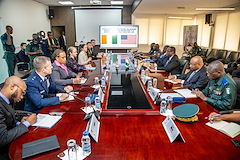
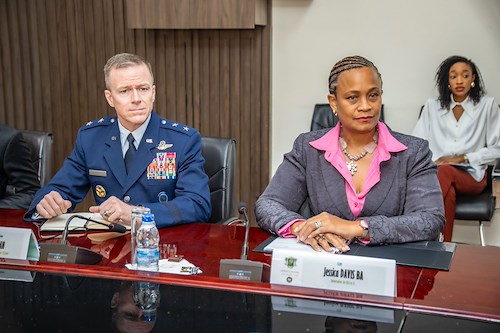
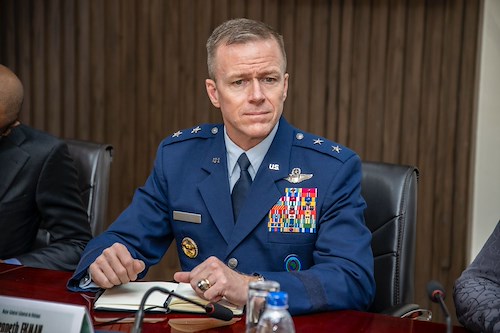
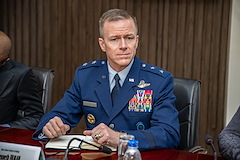
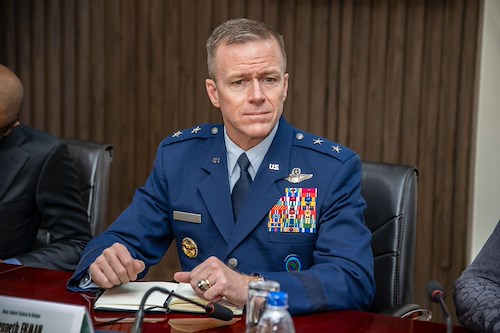
Ms. Amanda Dory, Acting Under Secretary of Defense for Policy, Ms. Maureen Farrell, Deputy Assistant Secretary of Defense for African Affairs, and U.S. Air Force Maj. General Kenneth Ekman, U.S. Africa Command (AFRICOM) Coordination Element visited with Côte d'Ivoire’s Minister of Defense M. Téné Birahima Ouattara during a key diplomatic trip aimed at strengthening defense and security cooperation between the United States and Coastal West Africa.
The AFRICOM Coordination Element (ACE) is part of the U.S. Africa Command (AFRICOM), a unified combatant command responsible for U.S. military activities across the African continent. The ACE supports AFRICOM's mission in West Africa by enhancing coordination, communication, and integration with various U.S. government agencies, host nations, and international partners.
Ms. Amanda Dory, Acting Under Secretary of Defense for Policy, Ms. Maureen Farrell, Deputy Assistant Secretary of Defense for African Affairs, and U.S. Air Force Maj. General Kenneth Ekman, U.S. Africa Command (AFRICOM) Coordination Element visited with Côte d'Ivoire’s Minister of Defense M. Téné Birahima Ouattara during a key diplomatic trip aimed at strengthening defense and security cooperation between the United States and Coastal West Africa.
The AFRICOM Coordination Element (ACE) is part of the U.S. Africa Command (AFRICOM), a unified combatant command responsible for U.S. military activities across the African continent. The ACE supports AFRICOM's mission in West Africa by enhancing coordination, communication, and integration with various U.S. government agencies, host nations, and international partners.
Ms. Amanda Dory, Acting Under Secretary of Defense for Policy, Ms. Maureen Farrell, Deputy Assistant Secretary of Defense for African Affairs, and U.S. Air Force Maj. General Kenneth Ekman, U.S. Africa Command (AFRICOM) Coordination Element visited with Côte d'Ivoire’s Minister of Defense M. Téné Birahima Ouattara during a key diplomatic trip aimed at strengthening defense and security cooperation between the United States and Coastal West Africa.
The AFRICOM Coordination Element (ACE) is part of the U.S. Africa Command (AFRICOM), a unified combatant command responsible for U.S. military activities across the African continent. The ACE supports AFRICOM's mission in West Africa by enhancing coordination, communication, and integration with various U.S. government agencies, host nations, and international partners.
Ms. Amanda Dory, Acting Under Secretary of Defense for Policy, Ms. Maureen Farrell, Deputy Assistant Secretary of Defense for African Affairs, and U.S. Air Force Maj. General Kenneth Ekman, U.S. Africa Command (AFRICOM) Coordination Element visited with Côte d'Ivoire’s Minister of Defense M. Téné Birahima Ouattara during a key diplomatic trip aimed at strengthening defense and security cooperation between the United States and Coastal West Africa.
The AFRICOM Coordination Element (ACE) is part of the U.S. Africa Command (AFRICOM), a unified combatant command responsible for U.S. military activities across the African continent. The ACE supports AFRICOM's mission in West Africa by enhancing coordination, communication, and integration with various U.S. government agencies, host nations, and international partners.
Ms. Amanda Dory, Acting Under Secretary of Defense for Policy, Ms. Maureen Farrell, Deputy Assistant Secretary of Defense for African Affairs, and U.S. Air Force Maj. General Kenneth Ekman, U.S. Africa Command (AFRICOM) Coordination Element visited with Côte d'Ivoire’s Minister of Defense M. Téné Birahima Ouattara during a key diplomatic trip aimed at strengthening defense and security cooperation between the United States and Coastal West Africa.
The AFRICOM Coordination Element (ACE) is part of the U.S. Africa Command (AFRICOM), a unified combatant command responsible for U.S. military activities across the African continent. The ACE supports AFRICOM's mission in West Africa by enhancing coordination, communication, and integration with various U.S. government agencies, host nations, and international partners.
Ms. Amanda Dory, Acting Under Secretary of Defense for Policy, Ms. Maureen Farrell, Deputy Assistant Secretary of Defense for African Affairs, and U.S. Air Force Maj. General Kenneth Ekman, U.S. Africa Command (AFRICOM) Coordination Element visited with Côte d'Ivoire’s Minister of Defense M. Téné Birahima Ouattara during a key diplomatic trip aimed at strengthening defense and security cooperation between the United States and Coastal West Africa.
The AFRICOM Coordination Element (ACE) is part of the U.S. Africa Command (AFRICOM), a unified combatant command responsible for U.S. military activities across the African continent. The ACE supports AFRICOM's mission in West Africa by enhancing coordination, communication, and integration with various U.S. government agencies, host nations, and international partners.
Ms. Amanda Dory, Acting Under Secretary of Defense for Policy, Ms. Maureen Farrell, Deputy Assistant Secretary of Defense for African Affairs, and U.S. Air Force Maj. General Kenneth Ekman, U.S. Africa Command (AFRICOM) Coordination Element visited with Côte d'Ivoire’s Minister of Defense M. Téné Birahima Ouattara during a key diplomatic trip aimed at strengthening defense and security cooperation between the United States and Coastal West Africa.
The AFRICOM Coordination Element (ACE) is part of the U.S. Africa Command (AFRICOM), a unified combatant command responsible for U.S. military activities across the African continent. The ACE supports AFRICOM's mission in West Africa by enhancing coordination, communication, and integration with various U.S. government agencies, host nations, and international partners.
US Defense Officials Conclude Visit to Benin and Côte d'Ivoire
10:26 AM1/8/2025
U.S. defense officials have concluded a successful visit to Benin and Côte d'Ivoire, focused on reinforcing defense and security cooperation with our key partners in Coastal West Africa. The delegation, led by Acting Under Secretary of Defense for Policy Amanda Dory, Deputy Assistant Secretary of Defense for African Affairs Maureen Farrell, and U.S. Air Force Maj. Gen. Kenneth Ekman, engaged in high-level discussions with senior defense leaders in both nations to enhance regional stability and address critical security challenges.
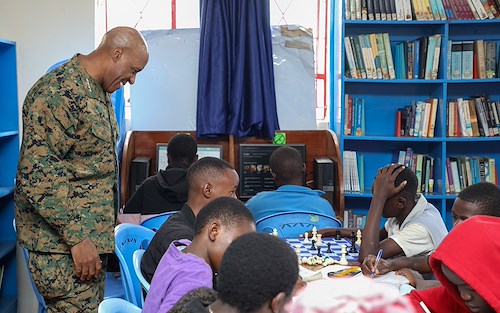
U.S. Marine Corps Gen. Michael Langley, commander, U.S. Africa Command observes a group of students attending Shining Hope for Communities' (SHOFCO) development program in Nairobi, Kenya, Nov. 26, 2024. While in Kenya, SHOFCO gave AFRICOM direct access to see how its community-led model for transformation is providing health care, sustainable livelihood programs, essential services, clean water, and building female leadership in impoverished communities to create lasting change. Combatting threats that drive instability starts with 3D,” said Langley. “As a 3D organization when enabling our African partners in a unified effort to promote regional security and prosperity, it requires a whole of government effort – Development, Diplomacy, and Defense.” (U.S. Department of Defense courtesy photo by Shining Hope for Communities)